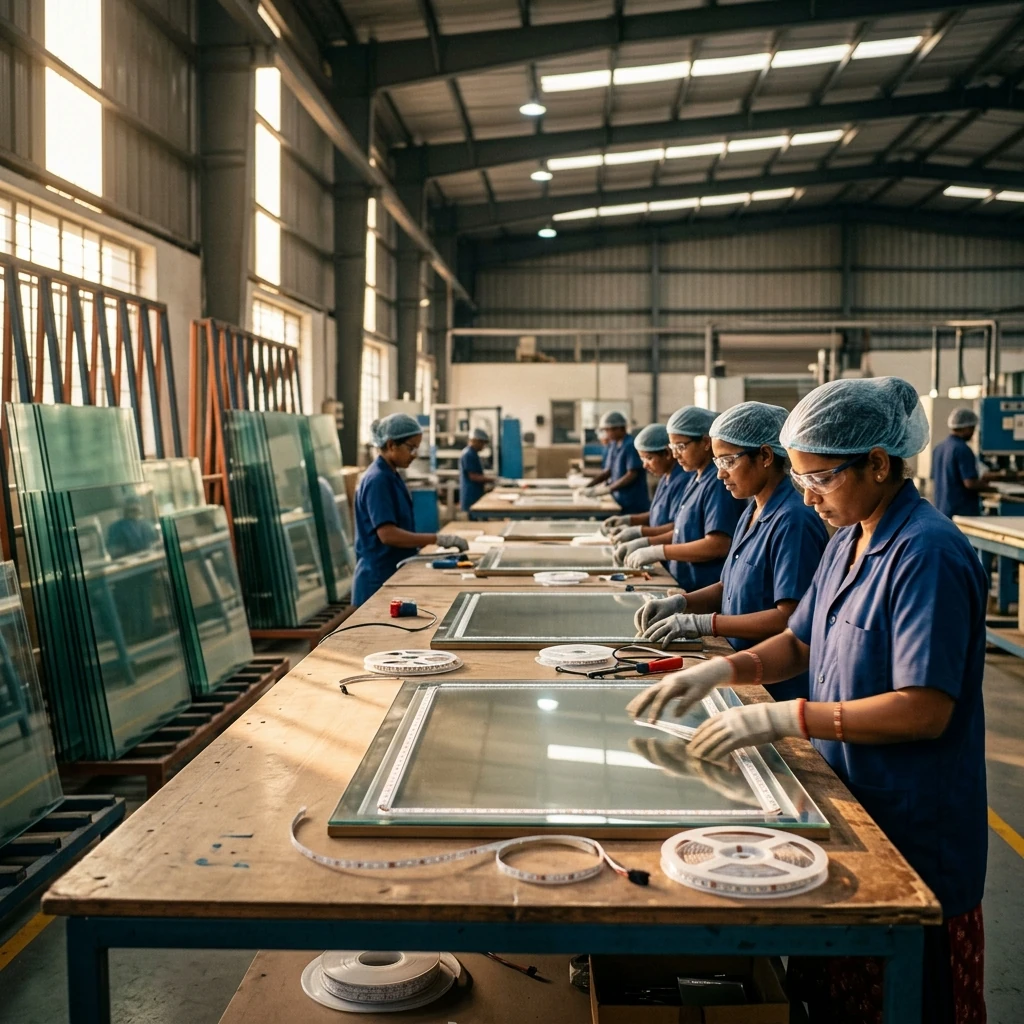
An LED mirror looks simple from the front, but its performance depends on a chain of decisions behind the glass. Understanding that chain helps you compare suppliers on useful evidence instead of broad claims about size or status.
The process begins with a clear specification
Before glass is cut, the maker needs an approved brief. It should state the finished width and height, orientation, shape, edge treatment, illuminated pattern, colour temperature, controls, mounting method and power position. Optional features such as dimming or a demister also need to be defined.
This stage matters because most changes become harder after cutting begins. For a custom order, ask for a written drawing or order summary and check every dimension against the finished wall, vanity and nearby fittings. A careful specification protects both the buyer and the maker.
Glass cutting and edge finishing shape the result
Mirror sheets are cut to the required outline, then the exposed edges are finished for the intended design. Straight rectangles, circles, arches and organic shapes require different handling. Holes or cut-outs for controls must align with the electrical layout behind the mirror.
Inspect the finished product for a consistent outline, smooth edge treatment and an undistorted reflective surface. On a framed model, also check the corner joins and the evenness of the gap around the glass. These visible details often reveal how carefully the specification was followed.
Creating an even illuminated area
Many LED mirrors use a prepared band or pattern that allows light to pass through or around the reflective layer. The width, spacing and diffusion of this area affect the appearance of the glow. Uneven preparation can create bright patches, dark sections or visible points of light.
Photographs can hide these problems, so ask to see a short, unedited video of the light switching on in a dim room. Look at the corners and curves as well as the centre. A good result should feel continuous and deliberate at the brightness level you expect to use.
Lighting and electrical integration
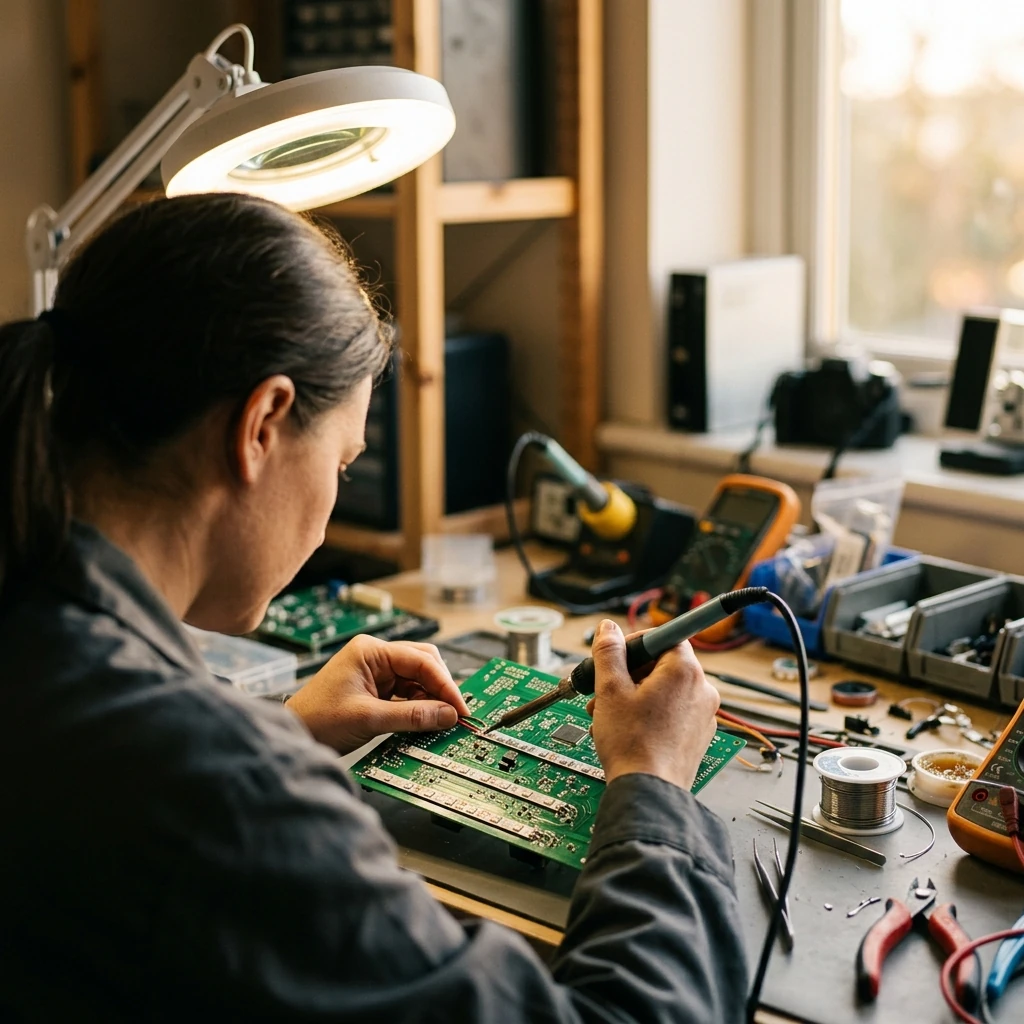
The lighting system may include LED modules or strips, a driver, switches or touch controls, and optional components such as a dimmer or demister. Their layout should support even light, heat management and future diagnosis. Cable routing and insulation should be neat and protected from sharp edges.
Ask for the declared input requirements and product documentation for the exact model. Bathroom suitability cannot be judged from styling alone: the product’s documented rating, its position in the room and local electrical requirements all matter. A qualified electrician should handle the final connection.
Assembly and quality checks
After the lighting and backing are assembled, the finished unit should be checked as a complete product. Useful checks include illumination across every section, touch or switch response, dimming and colour selection where fitted, demister operation, cable security, mounting stability and the condition of the glass.
Ask the seller what is checked before dispatch and how a problem is handled after delivery. A clear answer about service, parts and the claim process is more valuable than an unsupported promise that nothing will ever fail.
Packaging is part of manufacturing quality
A well-made mirror can still arrive damaged if the packaging does not protect the glass, corners, controls and rear components. Large or unusually shaped mirrors need packaging designed for their dimensions, along with clear handling orientation.
Before accepting delivery, inspect the outer packaging and follow the seller’s unpacking instructions. Record any visible damage promptly. For project orders, agree in advance how units will be labelled, delivered, stored and moved to the installation area.
Seven questions to ask an LED mirror supplier
Use the same questions when comparing quotes so the differences are easy to see:
- What are the exact finished dimensions, shape and edge or frame details?
- What light colour, control and dimming options are included?
- What electrical information and installation instructions are supplied?
- How can the driver, light source or controls be inspected and serviced?
- Which checks are completed before dispatch?
- How is the mirror packed, delivered and installed?
- What does the written warranty cover, and how is a claim raised?
Request one written specification that answers these points. It gives your architect, electrician and installer the same information and reduces surprises after production begins.
Custom mirrors and multi-unit projects
Custom production is useful when a standard size does not suit the wall or when a project needs a consistent family of shapes and finishes. Hotels, salons, builders and designers should also confirm sample approval, quantities, tolerances, labelling, delivery sequence and who is responsible for installation.
For a large order, begin with an approved sample or clearly documented specification. Repeatability matters as much as the first unit: colour appearance, control behaviour, mounting positions and visible dimensions should remain consistent across the order.
Frequently asked questions
How is an LED mirror made?
A typical LED mirror moves through specification, glass cutting and edge finishing, preparation of illuminated areas, integration of the lighting and electrical system, final assembly, functional checks and protective packing. The exact process varies by design and manufacturer.
What should I check before buying an LED mirror in India?
Request a written specification covering dimensions, glass and edge finish, lighting, controls, declared electrical ratings, installation requirements, delivery, service and warranty. Confirm that the selected model is suitable for its intended location.
How can I assess LED mirror manufacturing quality?
Look for consistent edge finishing and light diffusion, secure mounting, accessible service parts, clear electrical documentation, functional testing and packaging designed for glass. Ask the seller to put these details in writing.
Is a custom LED mirror better than a standard size?
A custom mirror is useful when the wall, vanity or design needs a particular proportion. A standard size can be simpler when it already fits. Quality depends on the specification and build, not on custom sizing alone.
Plan a mirror for your space.
Explore MirrorManShip designs or share your measurements for a custom quotation.
Explore LED mirrors → View catalogue →