The wrong mirror shape can make a beautifully tiled bathroom feel like an afterthought. A led bathroom mirror does more than reflect your face; it sets the visual tone of the entire vanity wall, influences how light moves through the room, and either complements or clashes with every other design decision you’ve made.
Recent NAR trend data confirms the shift: searches for oval bathroom vanity mirrors spiked 500% year over year, while capsule and arch shapes now dominate designer mood boards. Curved forms are a direct reaction to decades of boxy vanity setups that homeowners are finally ready to soften. Below, you’ll walk through each shape’s strengths, learn which rooms they work best in, and land on the right pick for your space.
Key Points
-
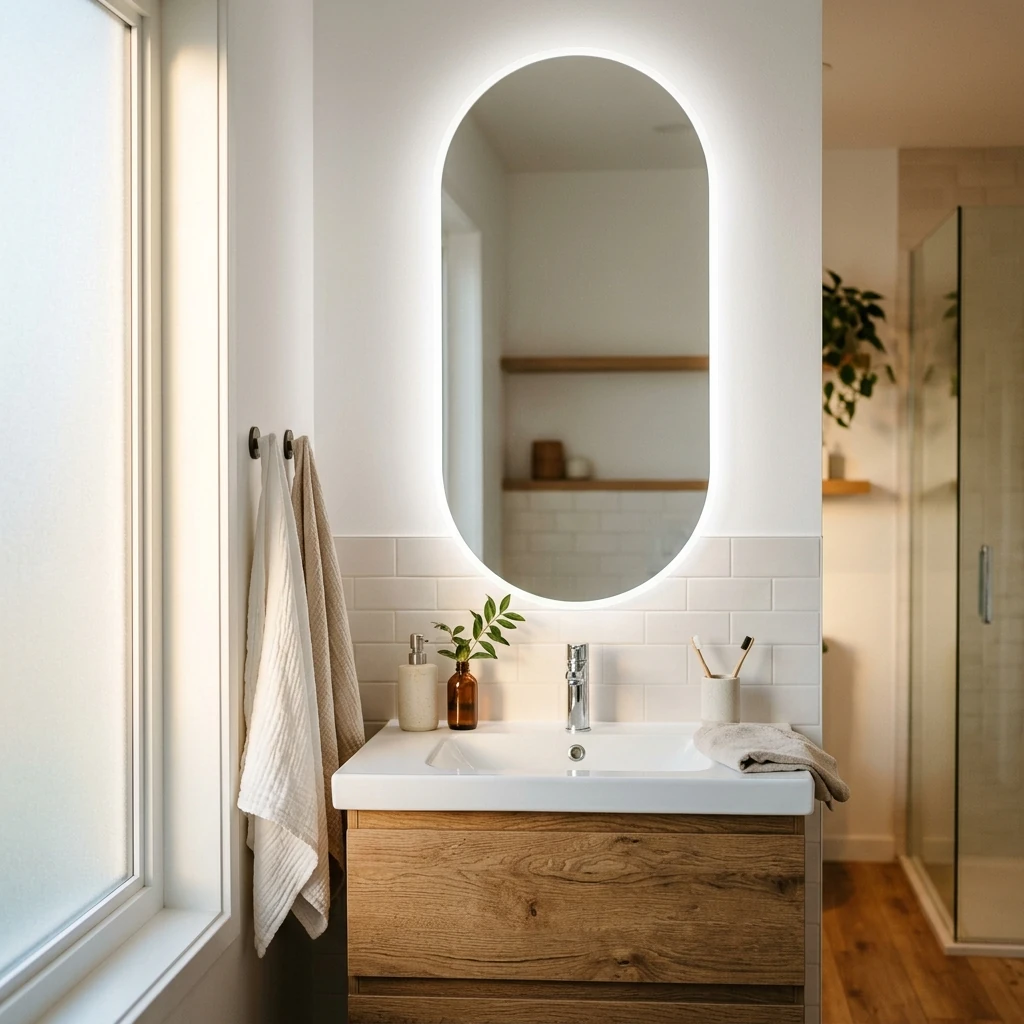
A capsule mirror has straight vertical sides with rounded top and bottom edges that draw the eye upward and make ceilings feel taller, which works especially well in narrow bathrooms or rooms with 8-foot ceilings where you need the illusion of more headroom without taking extra horizontal wall space.
-
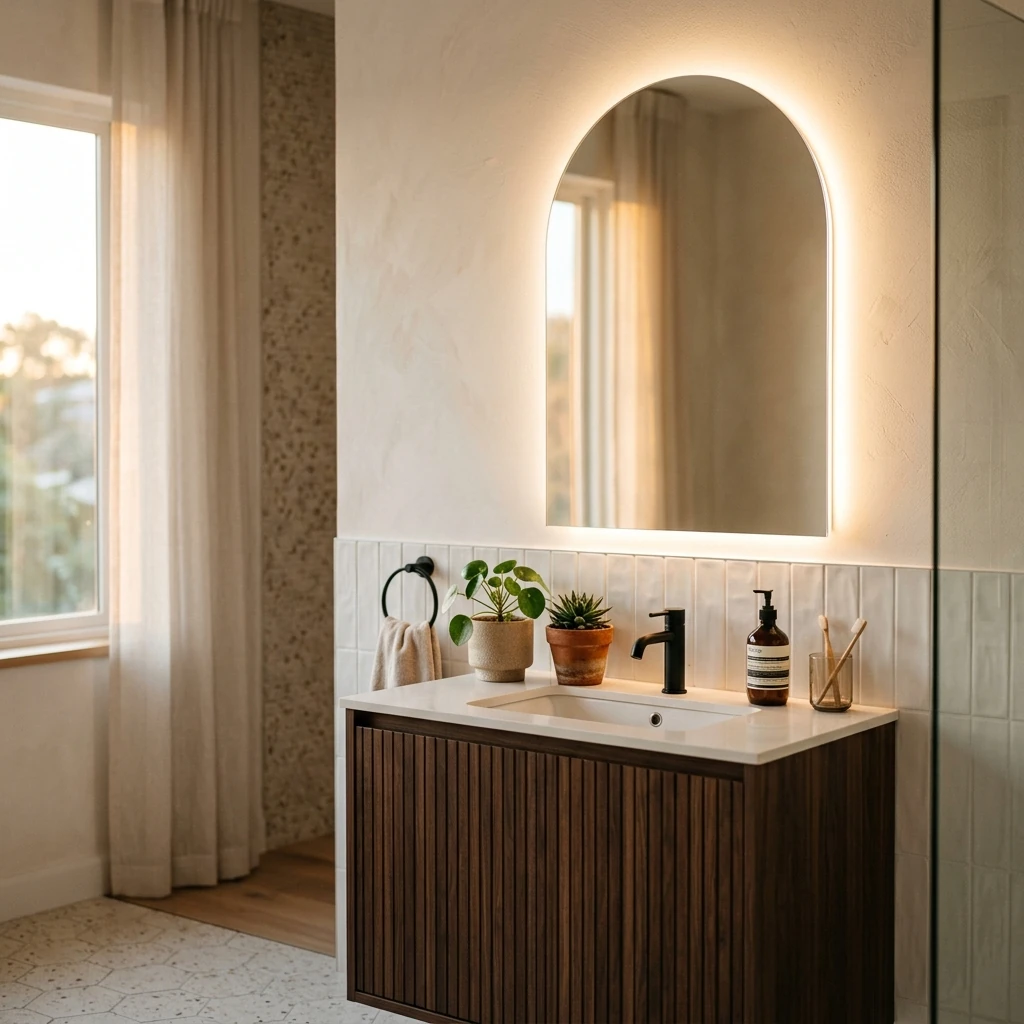
Arch mirrors keep a flat bottom edge that sits visually planted above the vanity while the curved top softens the upper wall, and they work especially well in bathrooms with hard geometric tile patterns because the arch provides contrast without competing.
-
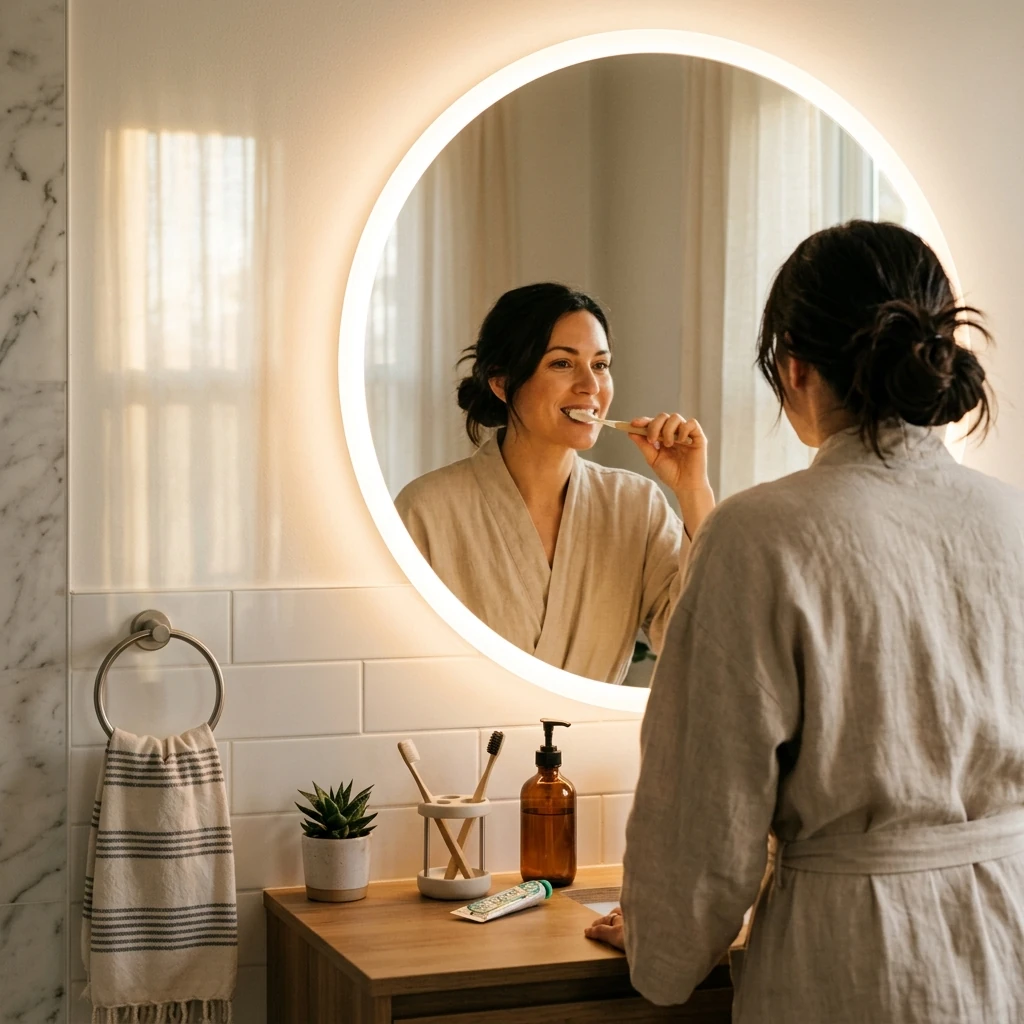
Round LED mirrors scatter integrated light more evenly across the perimeter than rectangular frames, but they demand breathing room and will feel squeezed on a cramped wall flanked by cabinets, so they work best on open expanses above floating vanities.
-
Standard mirrors use copper-backed glass that corrodes over time in humid bathrooms and shows as black spots creeping from the edges within three to five years, while copper-free glass eliminates that failure point entirely.
-
Off-the-shelf mirrors come in fixed increments like 24, 30, or 36 inches that rarely match your actual vanity width, leaving awkward gaps or slight overhangs, so custom architectural sizing ensures your mirror fits the vanity like it was designed together.
What is an LED bathroom mirror and how does shape affect your space?
Before comparing shapes, understand that mirror shape affects more than aesthetics.
It changes how your eye travels across the wall.
A capsule mirror (sometimes called a stadium or pill shape) has straight vertical sides with rounded top and bottom edges. That vertical emphasis draws the eye upward, which makes ceilings feel taller. If your bathroom runs narrow or your vanity sits below an 8-foot ceiling, a capsule creates the illusion of more headroom without taking up extra horizontal wall space.
Arch mirrors add architectural weight
An arch mirror keeps the flat bottom edge of a rectangle but crowns the top with a curve.
That flat base sits visually “planted” above the vanity, grounding the mirror while the arch softens the upper wall. Arch shapes borrow from doorways and windows, which is why they feel architectural rather than decorative.
They work especially well in bathrooms that already feature hard geometric tile patterns. The arch provides contrast without competing.
Round mirrors command open wall space
A round LED mirror is the most symmetrical option, and symmetry demands breathing room.
Mount a round mirror on a cramped wall flanked by cabinets, and it feels squeezed. Give it an open expanse above a floating vanity, and it becomes a focal point.
Round shapes also scatter integrated LED light more evenly across the perimeter, reducing the directional glow that rectangular frames sometimes create.
Matching your LED bathroom mirror shape to room layout
Shape selection starts with your room’s proportions and your actual wall geometry.
Here’s where we see homeowners trip up most often. They fall for a shape online, order it, and discover it fights the geometry of their actual wall.
Narrow bathrooms and powder rooms
Capsule mirrors earn their keep in tight spaces.
A 20″ × 32″ capsule above a pedestal sink makes a powder room feel taller without crowding the wall. Avoid round mirrors here unless the diameter stays under 24 inches; anything larger overwhelms the proportions.
If you’re also weighing size against wall dimensions, the LED Mirror Size Guide breaks down proportion rules worth checking before you commit.
Standard single-vanity setups
A 30- to 36-inch single vanity pairs well with either a capsule or an arch.
The deciding factor? Your backsplash and tile pattern.
Subway tile or stacked rectangles benefit from the curve of an arch. It breaks the grid without clashing. Hexagonal or mosaic tile already introduces visual complexity, so a simpler capsule keeps the wall from getting noisy.
Double vanity and wide-wall configurations
Wide walls change the calculus entirely.
Two matched arch mirrors above a double vanity create rhythm. Two round mirrors, on the other hand, can feel like eyes staring back at you.
A single oversized round mirror centered between two sinks works if the diameter exceeds 36 inches. Below that, it looks lost.
A recent Interior Design Institute guide on bathroom lighting reinforces why mirror shape matters beyond looks. Flanking LEDs reduce harsh shadows and improve grooming visibility, and a mirror’s perimeter shape determines how evenly that light distributes across your face. An arch mirror, for example, concentrates more LED surface area at eye level than a round mirror of the same height.
Glass quality and LED features that actually matter
Shape gets all the attention.
Glass quality does the heavy lifting.
Standard mirrors use copper-backed glass, which corrodes over time in humid bathrooms. You’ll see it as black spots creeping in from the edges, usually within three to five years. Copper-free glass (sometimes labeled “copper-free” or “green-edge”) eliminates that failure point entirely.
A recent Research and Markets report on luxury bathroom furniture noted that manufacturers winning market share offer custom-dimension LED mirrors with premium substrates and extended warranties. That tracks with what we see. Buyers who invest in shape and placement deserve glass that won’t degrade.
Colour temperature affects every shape
A round mirror with cool-white LEDs reads clinical.
The same mirror with warm-white LEDs feels like a boutique hotel. Most quality LED bathroom mirrors now offer tunable colour temperature, and that flexibility matters more than most buyers realize.
If you’re unsure which temperature suits your space, choosing between warm, natural, and cool LED colour temperature comes down to your wall colour and how much natural light the room gets.
Why custom sizing beats standard dimensions
Off-the-shelf mirrors come in fixed increments. 24″, 30″, 36″.
Your vanity doesn’t care about those increments. A 34-inch vanity with a 30-inch mirror leaves awkward gaps. A 36-inch mirror overhangs slightly and looks intentional, but only if the wall width accommodates it.
Custom architectural sizing solves this. MirrorManShip builds every mirror to your exact wall dimensions using 5mm copper-free glass, which means your capsule, arch, or round shape fits the vanity like it was designed together. Each mirror ships with a 5-year warranty, which is uncommon in a market where most brands cap coverage at one or two years.
So which shape should you actually choose?
Ask yourself two questions. Does your wall need vertical lift or a focal-point anchor? And does your tile pattern already introduce curves, or is it all straight lines?
Capsule for vertical lift and tight spaces. Arch for architectural contrast on grid-pattern walls. Round for open walls where the mirror can breathe. The shape should solve a spatial problem.
If you’re still weighing options, the comparison between round and rectangular mirrors covers additional layout scenarios worth considering alongside capsule and arch alternatives.
Frequently asked questions
How high should you hang an LED bathroom mirror above the vanity?
A practical starting point is to mount your mirror so the center lands around eye level for the primary users. Leave enough clearance above the faucet and countertop accessories so your mirror feels intentional rather than crowded.
Should your mirror be centered on the sink or centered on the vanity?
Centering on the sink typically looks best because it aligns with the plumbing and your daily use zone. If you have an off-center sink or asymmetrical vanity, prioritize the sink, then use lighting or decor to balance the rest of the wall.
What size mirror looks best over a floating vanity?
Floating vanities can visually handle a slightly taller mirror because there is less visual weight below. Aim for a size that feels proportional to your vanity width while leaving a consistent margin of wall space on both sides for a clean, architectural look.
Do you need side sconces if your mirror has built-in LED lighting?
Side sconces can improve depth and reduce shadows for tasks like shaving or makeup, but you may not need them. If you skip sconces, consider an LED mirror with strong, even front-facing illumination and a dimmer to adapt to different times of day.
What IP rating should you look for in an LED bathroom mirror?
Choose an IP rating that matches your mirror’s proximity to water. Higher protection is better for steamy bathrooms and splash zones. When in doubt, confirm the rating is suitable for bathroom use and meets local electrical code requirements.
How do you choose between a framed and frameless LED mirror?
Framed mirrors add contrast and can tie in hardware finishes like black, brass, or chrome, while frameless styles feel lighter and more modern. If your bathroom already has bold tile or fixtures, a simpler edge often keeps the wall from feeling busy.
What maintenance helps prevent mirror corrosion and keeps LEDs performing well?
Wipe the glass with a non-abrasive cloth and avoid harsh chemicals that can damage edge seals over time. Run your exhaust fan during and after showers to reduce humidity, and keep water from pooling along your mirror’s edges and electrical components.
Pick the shape your wall needs
Mirror shape is a spatial decision first and a style decision second.
Capsule mirrors stretch tight rooms upward. Arch mirrors ground themselves on the vanity while softening hard tile lines. Round mirrors anchor wide, open walls. Each one redistributes LED light differently, changes perceived ceiling height, and either harmonizes with or disrupts your existing geometry.
Measure your wall. Note your tile pattern. Then pick the shape that fixes the problem you didn’t know you had.
Get a mirror built for your exact wall
MirrorManShip is the studio to call when standard sizes fall short. Every LED bathroom mirror is custom-built to your architectural dimensions with 5mm copper-free glass and backed by a 5-year warranty. Whether you need a 22-inch capsule for a powder room or a 40-inch arch for a double vanity, your mirror arrives sized to your wall. Start your custom mirror design and get the shape, size, and light your bathroom actually needs.
Ready to find your mirror?
Explore shapes, lighting and sizes across the MIRRORMANSHIP collection.
Explore LED mirrors → View catalogue →