LED bathroom mirrors with built-in defoggers solve a problem most people don’t realize they’re tired of: wiping condensation off the glass every single morning, mid-shower, and again after washing your face. That fog slows your routine, streaks your mirror, and makes precise grooming nearly impossible in a steamy bathroom.
The National Association of Realtors spotlighted smart bathroom upgrades at a recent Consumer Electronics Show, noting that LED mirrors with anti-fog heaters and tunable lighting are now viewed as ROI-positive features that differentiate listings. That shift tells you something: these mirrors aren’t a novelty anymore. Below, you’ll find the specs that actually matter when choosing one, the trade-offs between models, and a few pitfalls we see buyers walk into repeatedly.
Key Points
-
Defogger pads use a resistive polyester film that heats the glass 10-15°F above ambient temperature, drawing between 15 and 30 watts, roughly the energy cost of a single LED bulb.
-
An IP44 rating is the minimum for mirrors near showers or tubs, while IP65 or higher is necessary for mirrors directly above bathtubs or inside wet rooms.
-
Defogger pads typically cover only a central portion of the mirror surface, so on a 36″ × 28″ mirror the heated area might only be 20″ × 16″, leaving edges prone to fog in double-vanity setups.
-
Most LED bathroom mirrors with defoggers require a hardwired junction box behind the mirror rather than a standard outlet, so budget for an electrician if your bathroom lacks one at mirror height.
-
Tunable color temperature between warm 3000K and cool 6000K light matters because fixed 6000K washes out skin tone and makes makeup application unreliable.
-
Infrared sensors that activate with a wave sidestep the problem of capacitive touch controls misreading water droplets as touch inputs when your fingers are wet.
What are led bathroom mirrors?
LED bathroom mirrors integrate energy-efficient LED lighting directly into the mirror frame or behind the glass surface. Many models include a defogger pad bonded to the back of the mirror that prevents condensation from forming.
A standard bathroom mirror fogs because its surface temperature drops below the dew point of the surrounding air. Hot shower steam hits cold glass, and you get a wall of condensation.
Defogger pads fix this with a thin heating element bonded to the back of the mirror.
Most draw between 15 and 30 watts, which is roughly the energy cost of a single LED light bulb running for the same period. The pad raises the glass surface temperature just enough to prevent condensation from forming.
Pair that with integrated LED lighting and you eliminate two problems at once: poor visibility and fog.

How defogger heating pads actually work
Most defogger pads use a resistive polyester film. Think of it like a very flat, very low-power electric blanket glued behind the mirror.
When you activate it, the film heats the glass to roughly 10–15°F above ambient temperature.
Some models tie the defogger to the same switch as the LED lights, so both activate together. Others give you an independent switch.
We’d recommend the independent switch every time. Why?
Because you don’t always need both functions running simultaneously, and separating them extends the lifespan of the heating element.
The NKBA’s sustainable bathroom design guidance recommends specifying LED mirrors with independent defog switches alongside IP-rated moisture protection as part of an eco-friendly fixture checklist. That independent switch detail matters more than most product listings suggest.
Features that separate great led bathroom mirrors from average ones
Once you’ve committed to a defogger-equipped mirror, the feature list gets long fast.
Does every feature earn its price premium, though?
Here’s where to focus your budget and where to push back.
IP rating and moisture protection
An IP44 rating is the minimum you want for a bathroom mirror installed near a shower or tub. The first “4” means the mirror is protected against objects larger than 1mm (like small tools or wires).
The second “4” means it can handle water splashing from any direction.
If your mirror sits directly above a bathtub or inside a wet room, look for IP65 or higher.
Skipping this detail is how electrical failures happen two years in.
Light temperature and dimming controls
Tunable color temperature changes how useful a mirror actually is. A fixed 6000K (cool white) works fine for detailed tasks like shaving.
But it washes out your skin tone, which makes makeup application unreliable.
The best LED bathroom mirrors let you shift between warm (3000K) and cool (6000K) light. Dimmability matters too.
Full brightness at 3 AM when you’re half asleep isn’t a feature; it’s a punishment.
If you’re weighing how light placement affects daily use, understanding how to avoid shadows on your face with bathroom mirror lighting makes a real difference in which model you pick.
Touch controls versus physical switches
Touch-sensitive controls look sleek, but they come with a trade-off. Wet fingers and capacitive sensors don’t always cooperate.
Some mirrors misread water droplets as touch inputs.
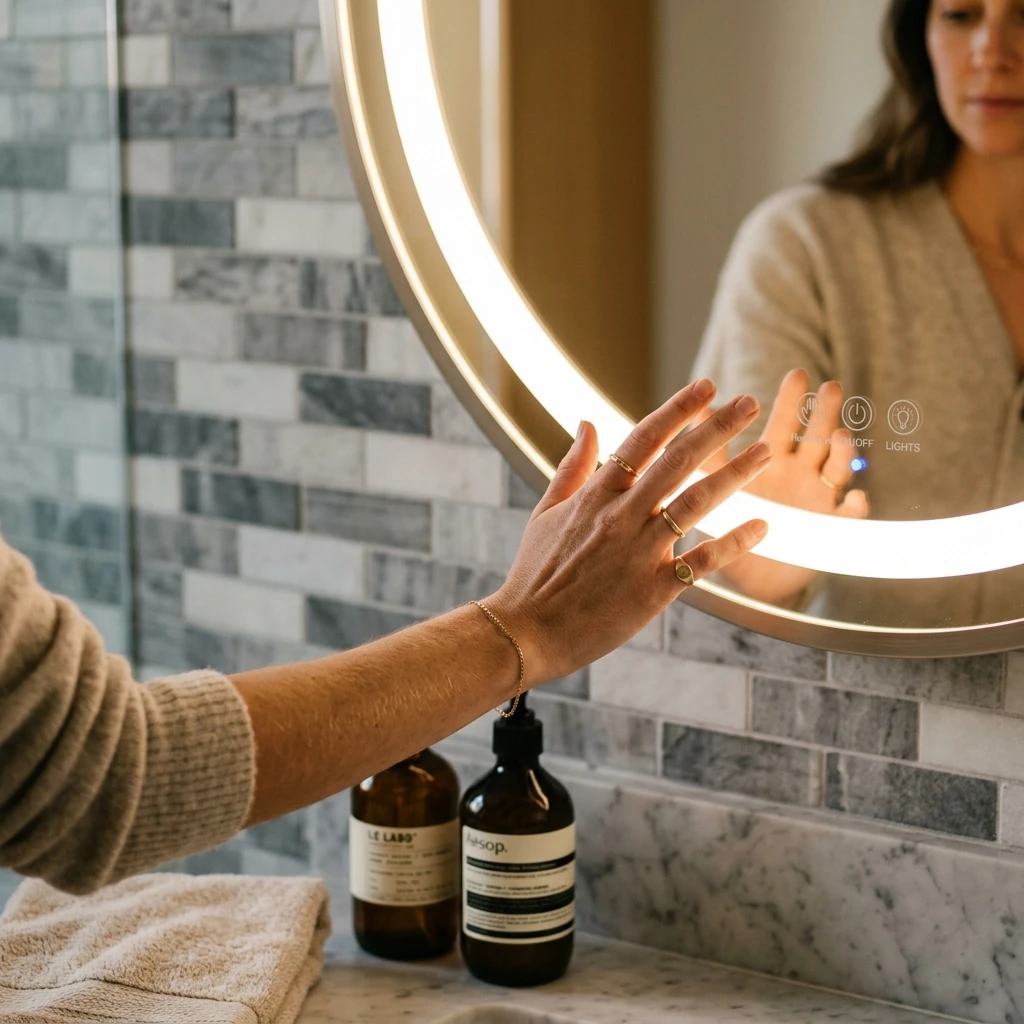
Higher-end models use IR (infrared) sensors instead, which activate with a wave of your hand rather than direct contact. That sidesteps the wet-finger problem entirely.
For a closer look at control options, custom LED bathroom mirrors with touch controls break down what’s available and when each type makes sense.
Sizing and placement for led bathroom mirrors with defoggers
Most buyers default to “as big as the vanity” when choosing mirror size. That’s a reasonable starting point, but defogger coverage complicates it slightly.
Defogger pads don’t typically cover the entire mirror surface.
On a 36″ × 28″ mirror, the heated area might only cover a central 20″ × 16″ section. That’s usually enough for one person’s face and upper body, but if two people use the mirror side by side, the edges will still fog.
For double-vanity setups, two separate mirrors with individual defogger pads outperform one oversized mirror with a single pad.
You also get independent lighting controls, which matters when one person is awake and the other isn’t.
Small bathrooms present a different challenge. If space is tight, the mirror’s LED output becomes your primary light source.
A guide to the best mirror ideas for a small bathroom covers how to maximize both light and the feeling of space in compact layouts.
Electrical requirements you should verify first
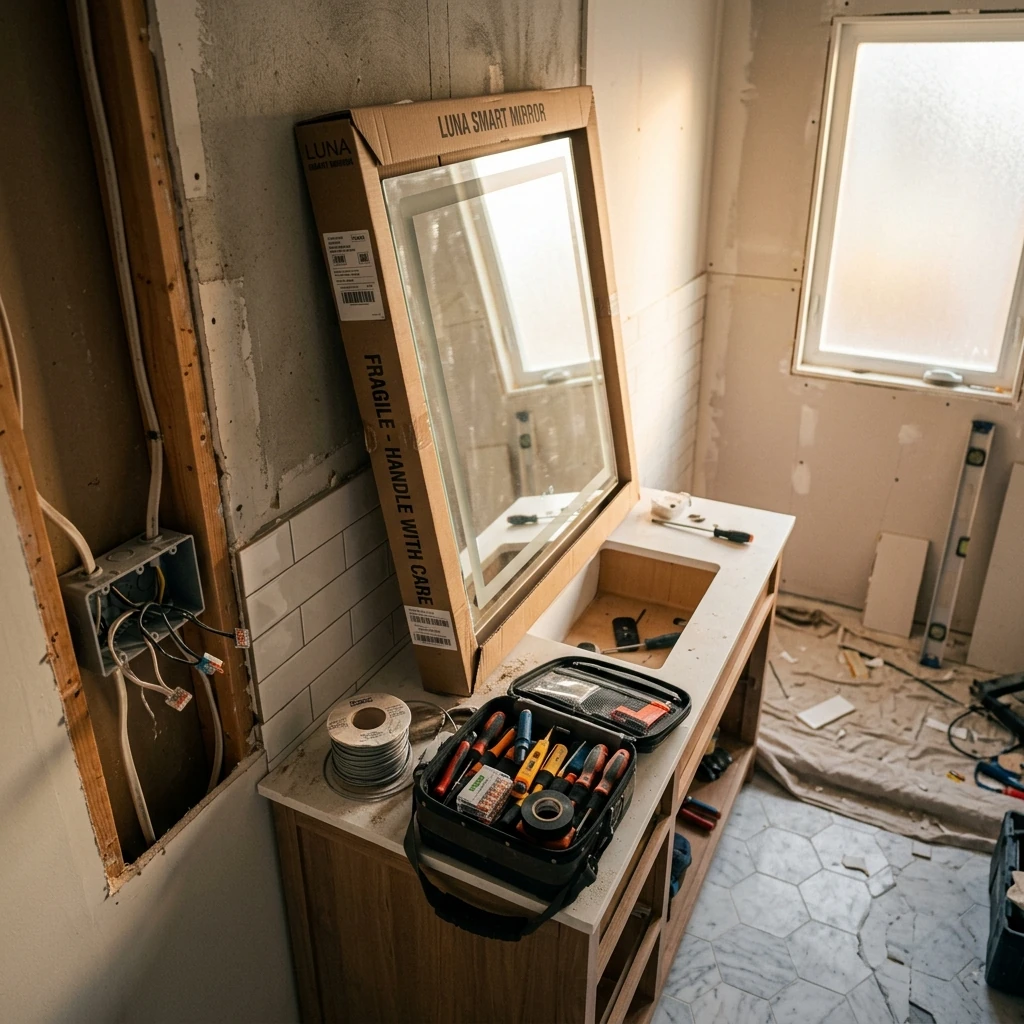
Most LED bathroom mirrors with defoggers need a hardwired connection. That means a junction box behind the mirror at the correct height.
If your bathroom doesn’t already have a junction box at mirror height, budget for an electrician.
Running a new line typically costs depending on your wall type and local rates. Some plug-in models exist, but they tend to have weaker defogger performance and visible cords that undercut the clean aesthetic you’re paying for.
Common mistakes when buying led bathroom mirrors with defoggers
We see three mistakes come up more than any others.
Ignoring the defogger pad size relative to the mirror. A beautiful 48-inch mirror with a 14-inch defogger pad defeats the purpose.
Always check the heated area specification and compare it to the total mirror dimensions.
Choosing the cheapest no-name brand. LED bathroom mirrors sit in a humid environment for years. Low-quality sealants degrade.
Moisture infiltrates the LED strips. The defogger pad delaminates from the glass.
Grand View Research estimates the global LED lighting market will reach US$115.2 billion in the coming years, which means there’s no shortage of manufacturers competing on price alone. Cheap entry points don’t guarantee reliable bathroom-grade components.
Skipping the IP rating check. A mirror rated IP22 belongs in a bedroom, six feet from a running shower.
If you want a fuller buying framework before committing, the best LED mirror buying guide covers specs, warranties, and red flags in more detail.
Frequently asked questions
How long does it take for a defogger mirror to clear after a hot shower?
Most mirrors perform best when you turn on the defogger a few minutes before your shower. If you switch it on afterward, clearing time depends on your bathroom humidity, ventilation, and how much of the glass is covered by the heating pad.
Do LED mirrors with defoggers require special cleaning products?
Use a non-abrasive microfiber cloth and an ammonia-free glass cleaner to protect coatings and edge seals. Avoid soaking the edges or spraying cleaner directly into seams, apply it to your cloth first to reduce moisture intrusion over time.
What safety certifications should I look for in an LED bathroom mirror?
Look for recognized electrical safety marks such as UL, ETL, or CSA, and confirm the listing applies to your complete mirror. For added confidence, choose models that clearly document bathroom-appropriate installation requirements and testing.
Can I install an LED defogger mirror on a GFCI circuit?
Yes, and it is often recommended for bathroom safety. Confirm your mirror’s wiring method matches your setup, then have a licensed electrician verify proper grounding and GFCI protection based on local code.
Will a defogger prevent fog everywhere in the bathroom?
No, it only keeps your mirror’s heated area clear. Better ventilation, such as using your exhaust fan during and after showers, helps reduce overall condensation on walls, fixtures, and unheated mirror edges.
What should I consider if I want a mirror with both a defogger and smart features?
Check whether smart controls allow separate control of lighting and defogging, plus settings like timers or auto shutoff. Also confirm the brand supports firmware updates, replacement parts, and a clear warranty process for electronics in humid environments.
How do I choose the right mirror shape and edge style for my bathroom design?
Match your mirror geometry to nearby lines, rectangular mirrors complement linear vanities and tile grids, while round or pill shapes soften angular spaces. Edge-lit designs create a halo effect for ambiance, while front-lit styles can provide more direct task illumination for grooming.
Choose your mirror based on function and fit
The right LED bathroom mirror with a defogger fits your bathroom’s electrical setup, handles your humidity level, and covers enough surface area to stay clear where you actually need it. Prioritize IP rating, defogger pad coverage, and independent switching.
Those three specs separate mirrors that work reliably from mirrors that look good in product photos and disappoint within a year.
Start by measuring your available wall space and identifying where your junction box sits. Then match those dimensions to a mirror whose heated area covers the zone you use most. Check the IP rating against your bathroom’s moisture exposure, and confirm the defogger and lighting can be controlled separately.
When you choose based on how you’ll actually use the mirror rather than how it photographs, you end up with a fixture that improves your routine every morning instead of one that sits on a return pallet.
Pick the mirror that matches your bathroom
MirrorManShip offers customizable LED bathroom mirrors with defogger options across a range of sizes and lighting configurations. If you need specific dimensions or want to match an unusual vanity layout, explore MirrorManShip’s full collection to find a mirror built around your bathroom rather than the other way around.
Ready to find your mirror?
Explore shapes, lighting and sizes across the MIRRORMANSHIP collection.
Explore LED mirrors → View catalogue →